A pattern is never made to the exact final size of the part. Pattern allowances are deliberate size adjustments built in during design, and getting them wrong is one of the most common causes of casting rejection. This reference covers why pattern allowances exist, the main types, how to choose pattern materials, and how allowances are applied in real projects.
Understanding pattern allowances properly is one of the clearest ways to tell an experienced pattern shop from one that’s simply copying a drawing without engineering judgement. Every dimension on a finished casting traces back to an allowance decision made months earlier at the pattern stage.
Why Pattern Allowances Exist
There isn’t a single reason pattern allowances exist — they respond to several separate physical realities of the casting process, each of which needs its own calculation.
Metal shrinkage during solidification
Every metal contracts as it cools from liquid to solid. Pattern allowances compensate for this shrinkage so the finished casting — not the pattern — ends up at the correct size.
Withdrawal and finishing needs
Beyond shrinkage, pattern allowances also account for practical needs like pulling the pattern cleanly from the mould and leaving enough stock for later machining. These two needs alone account for most of the size difference between a pattern and its finished casting.
Consequences of wrong allowances
Incorrect pattern allowances show up as undersized, oversized, or warped castings — problems that are expensive to trace back once production has already started. Reworking pattern allowances after tooling is cut costs far more than getting the calculation right the first time.
The Main Types of Allowance
In practice, pattern allowances break down into five distinct categories, each solving a different problem in the casting process.
Shrinkage and draft
- Shrinkage allowance — extra size added to compensate for metal contraction on cooling.
- Draft allowance — a slight taper on vertical faces so the pattern releases cleanly.
Typical shrinkage allowance by metal
| Metal | Typical linear shrinkage |
| Grey cast iron | ~1.0% |
| SG (ductile) iron | ~1.0–1.2% |
| Aluminium | ~1.3–1.5% |
| Steel | ~2.0–2.5% |
Machining and distortion
Machining allowance leaves extra stock on surfaces to be machined after casting. Distortion allowance corrects for parts — often U-shaped or long, thin sections — that tend to warp as they cool unevenly.
Shake/rapping allowance
Shake allowance accounts for the pattern being rapped loose before withdrawal, which slightly enlarges the cavity
— a detail that needs to be factored into pattern allowances from the start, not corrected afterward.
Choosing Pattern Materials
Pattern allowances and pattern material choice are closely linked — a metal pattern holds its calculated allowances accurately for far longer than a wood one under repeated use.
Wood, metal, plastic and resin
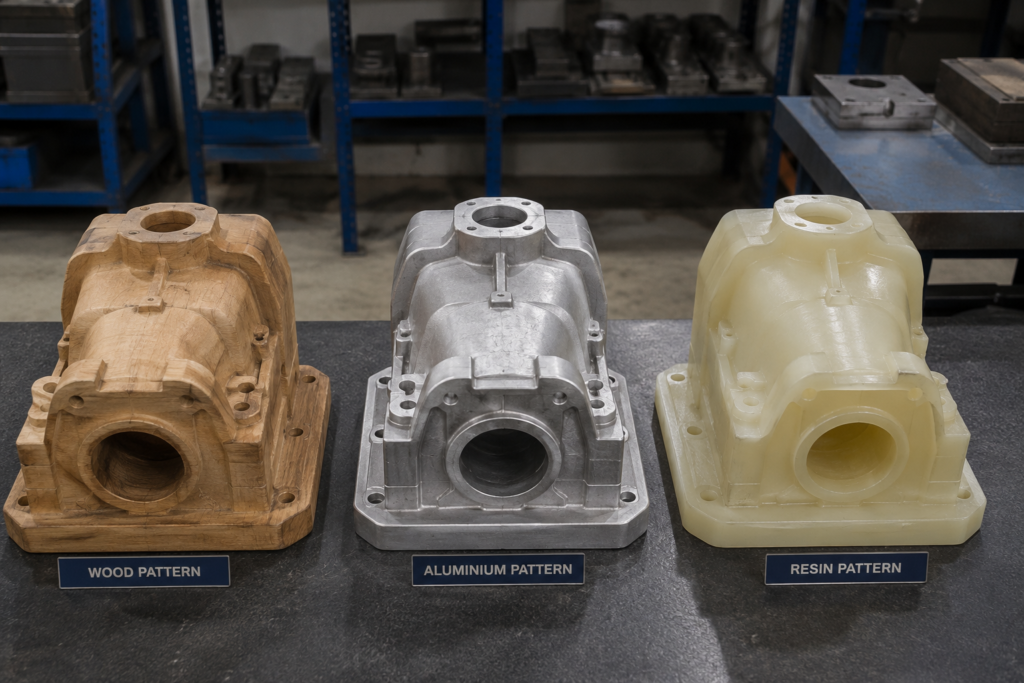
Wood is cheap and fast to shape, suited to prototypes. Metal (aluminium or steel) holds pattern allowances accurately over thousands of cycles. Plastic and resin sit in between on cost and durability.
Quick material comparison
| Material | Cost | Durability | Best for |
| Wood | Low | Low | Prototypes, one-offs |
| Resin/Plastic | Medium | Medium | Small-medium batches |
| Aluminium | Medium-high | High | Repeat production |
| Steel | High | Very high | Very high volume |
Volume-based selection
Production volume is usually the deciding factor: low-volume work rarely justifies a metal pattern, while high-volume shell moulding rarely tolerates a wood one.
Cost and durability trade-offs
A pattern with well-calculated allowances but the wrong material still fails early — durability and dimensional stability need to be matched to the expected production life.
Applying Allowances in Real Projects
Theory only goes so far — applying pattern allowances correctly on an actual project means working through real numbers against a real drawing.
Worked examples
For a 100 mm aluminium casting dimension, a 1.4% shrinkage allowance adds roughly 1.4 mm to the pattern size — before draft and machining allowances are layered on top. This is a simplified version of how pattern allowances are actually calculated on a live project.
Material-specific shrinkage values
Pattern allowances always start from the specific metal being cast — the shrinkage table above is a starting reference, refined further for each foundry’s actual practice.
Verification and inspection
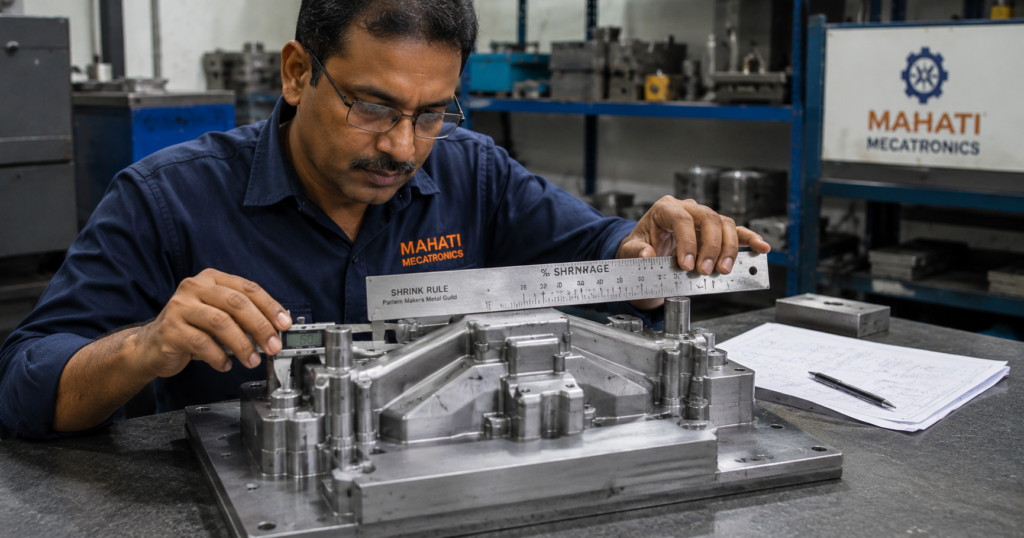
Every finished pattern is checked with a shrink rule and callipers against the original drawing before it’s approved for the foundry floor.
Get Your Pattern Allowances Calculated Correctly
Mahati Mecatronics applies precise pattern allowances and recommends the right material for your volume and part.
Frequently Asked Questions
Q. What is shrinkage allowance in pattern making?
It is extra size added to the pattern to compensate for the metal contracting as it cools, so the finished casting reaches the correct dimensions.
Q. Why is draft allowance needed?
Draft is a slight taper on vertical faces that lets the pattern be withdrawn from the mould without damaging it.
Q. Which pattern material lasts longest?
Metal patterns last longest and are preferred for high-volume shell moulding; wood is economical for low volumes and prototypes.