Accurate, repeatable machining depends on more than a good CNC programme — it depends on how the part is held. As a jigs and fixtures manufacturer, Mahati designs and machines the workholding, tooling and dies that keep foundries and machine shops running to tolerance, cycle after cycle.
Working with an experienced jigs and fixtures manufacturer from the design stage — rather than treating workholding as an afterthought — is usually what separates a smooth production ramp-up from months of avoidable rework.
What Jigs and Fixtures Do
Before comparing tooling options, it helps to be clear on what jigs and fixtures actually do differently on the shop floor — and why a jigs and fixtures manufacturer treats the two as distinct products.
Difference between a jig and a fixture
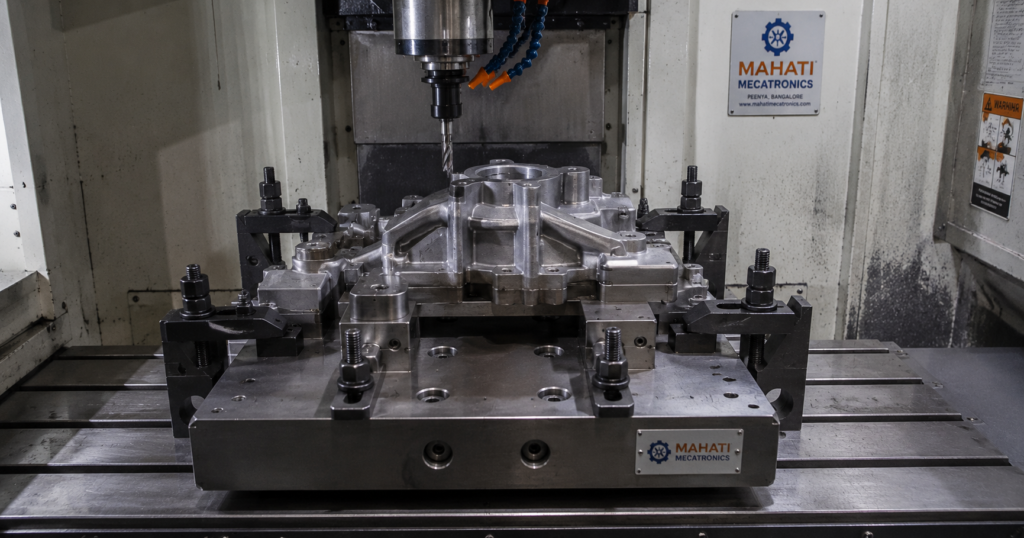
A jig guides the cutting tool as well as holding the workpiece; a fixture only holds and locates the part. As a jigs and fixtures manufacturer, Mahati builds both, depending on the operation and the accuracy required.
Jig vs fixture at a glance
| Type | Guides the tool? | Typical use |
| Jig | Yes | Drilling, reaming |
| Fixture | No — locates only | Milling, welding, inspection |
Where they add accuracy and speed
Good workholding removes guesswork from every cycle — the same reason any serious jigs and fixtures manufacturer treats tooling design as engineering, not an afterthought. A well-designed fixture also cuts setup time between parts, which adds up quickly across a production run.
Typical foundry and machine-shop uses
Jigs and fixtures are used across drilling, milling, welding and inspection stations — anywhere repeatable part location matters. A single jigs and fixtures manufacturer relationship often covers all of these stations for one customer.
Tooling and Dies We Manufacture
Beyond core workholding, a full-service jigs and fixtures manufacturer typically also produces the dies and moulds that shape parts directly — Mahati’s scope covers both.
Press tools and forging dies
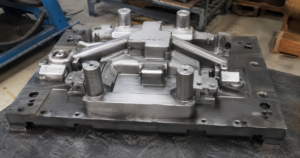
Beyond workholding, Mahati manufactures press tools and forging dies for shaping metal under load, built from hardened tool steel for extended service life.
Blow moulds
Blow mould tooling is machined to the cavity geometry required for plastic forming applications, alongside the core jigs and fixtures manufacturer scope — one supplier covering both workholding and mould tooling.
Injection and rubber mould dies
Injection moulding and rubber mould dies round out the tooling range at Mahati, engineered for consistent part geometry across long production runs — the same standard applied to every jig, fixture and die leaving the workshop.
Designing Reliable Tooling
Reliability is what customers actually pay a jigs and fixtures manufacturer for — tooling that performs the same way on cycle 10,000 as it did on cycle one.
Material and hardness selection
Tool steel grade and hardness are chosen based on expected cycle count and the material being formed — a decision every experienced jigs and fixtures manufacturer makes at the design stage, not after wear appears.
Common tool steel grades
- D2 — high wear resistance, common for press tools.
- H13 — hot-work grade, suited to forging dies.
- P20 — pre-hardened, common for mould tooling.
Tolerance and repeatability
Every jigs and fixtures manufacturer lives or dies on repeatability — a fixture that locates a part slightly differently each cycle defeats its own purpose. Repeatability is tested and confirmed before any tooling from a jigs and fixtures manufacturer is released to production.
Maintenance and tool life
Wear surfaces are designed for periodic inspection and refurbishment, extending tool life well beyond the first production run.
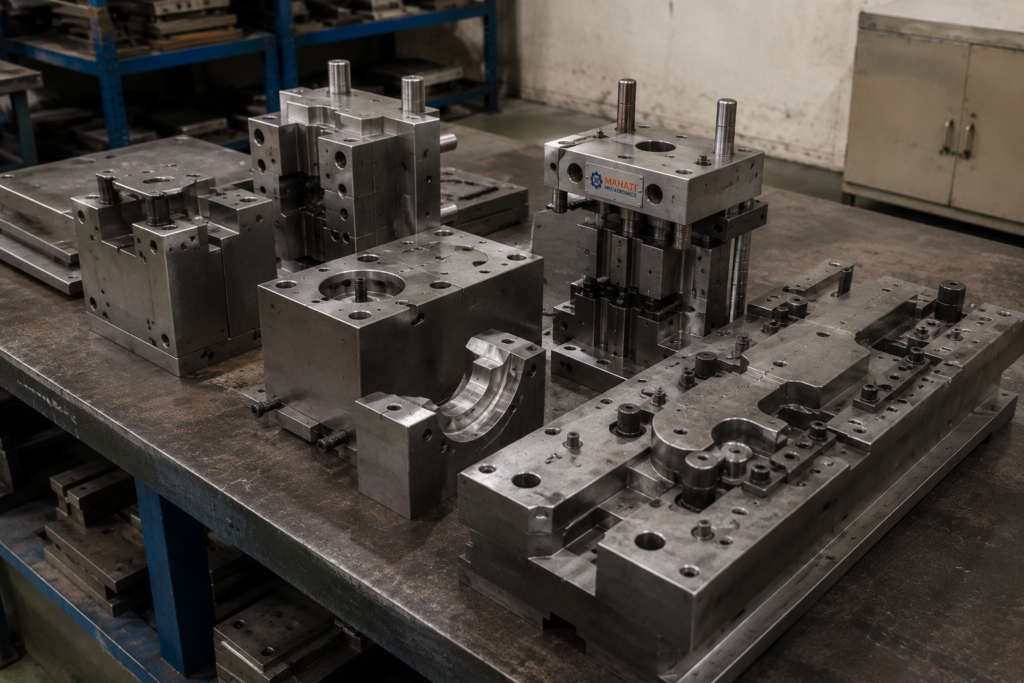
Getting Custom Tooling Made
Bringing on a jigs and fixtures manufacturer for a new project usually follows the same three-step path, regardless of tooling complexity.
From drawing or sample
As a jigs and fixtures manufacturer, Mahati can start from either a formal drawing or a physical sample part — whichever is available at the enquiry stage.
In-house machining and inspection
All tooling is machined and inspected in-house at the Bangalore facility before dispatch — a core part of working with any dependable jigs and fixtures manufacturer.
Lead times and support
Lead times vary with tooling complexity — a straightforward fixture moves faster than a multi-cavity mould die. As a jigs and fixtures manufacturer with in-house machining, Mahati keeps customers updated at each stage.
Talk to Our Jigs and Fixtures Manufacturer Team
Mahati Mecatronics designs and machines custom jigs, fixtures, press tools and dies in Peenya, Bangalore.
Frequently Asked Questions
A few questions come up in almost every conversation with a prospective jigs and fixtures manufacturer client — answered directly below.
Q. What is the difference between a jig and a fixture?
A jig guides the cutting tool as well as holding the work, while a fixture only holds and locates the workpiece; both improve accuracy and repeatability.
Q. Do you make press tools and forging dies?
Yes — press tools, forging dies, blow moulds and injection/rubber mould dies are designed and manufactured in-house.
Q. Can you work from just a sample part?
Yes; send a drawing or a physical sample and the required tooling can be engineered from it.