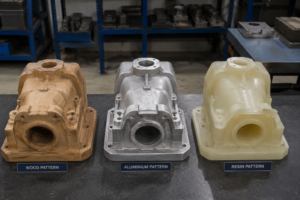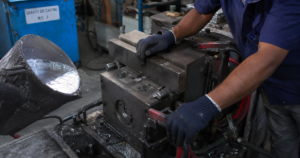
As a sand casting manufacturer, Mahati produces castings across cast iron, SG iron, aluminium, steel and brass — from small brackets to large housings. This guide covers how sand and shell casting work, the parts commonly cast, material options, and how quality is checked before dispatch.
Choosing the right sand casting manufacturer matters as much as choosing the right process — consistent quality across a production run depends on tooling accuracy and foundry discipline as much as the casting method itself. A dependable sand casting manufacturer also advises on which process, sand or shell, actually fits a given part.
How Sand and Shell Casting Work
Every sand casting manufacturer offers some version of both processes, since each solves a different combination of volume, cost and finish requirements.
The sand casting process
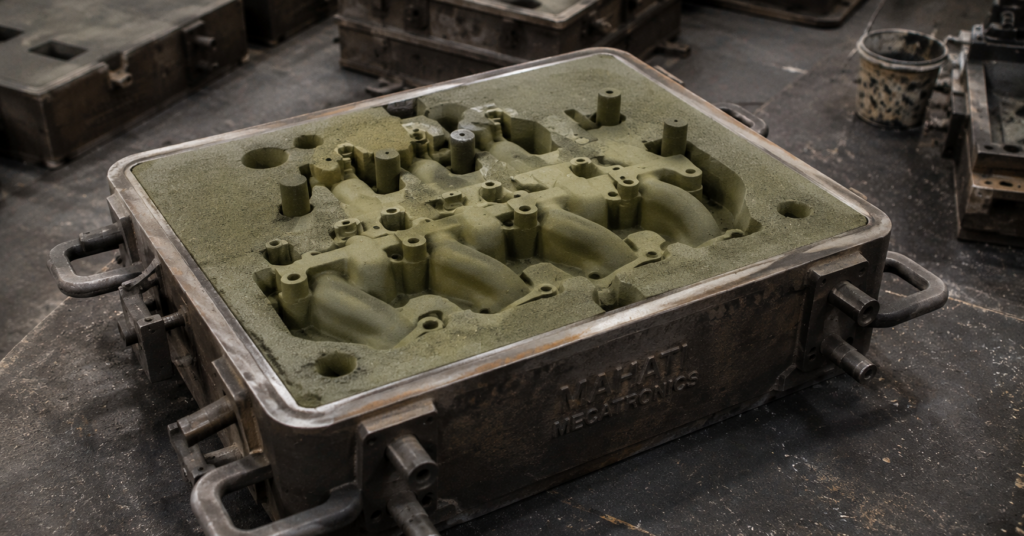
Sand casting packs sand around a pattern to form a mould, broken apart after each pour. As a sand casting manufacturer, this is the default starting process for new parts, low volumes, and large castings.
How shell moulding differs
Shell moulding uses resin-coated sand cured against a heated pattern, giving tighter tolerances and a smoother finish than conventional green-sand work — many customers move from a sand casting manufacturer’s standard process to shell moulding once volumes justify it. A good sand casting manufacturer explains this trade-off clearly before quoting.
Choosing between the two
The decision usually comes down to volume and finish requirements — a sand casting manufacturer can typically advise which process suits a given part after reviewing the drawing, weighing tooling cost against expected order volume.
Sand vs shell quick comparison
| Factor | Sand casting | Shell moulding |
| Tooling cost | Lower | Higher |
| Surface finish | Standard | Smooth |
| Best volume | Low-medium | Medium-high |
Parts We Cast
As a sand casting manufacturer with in-house pattern making, Mahati produces a wide range of components across sand and shell processes — a capability that comes directly from controlling the pattern shop and foundry floor under one roof.
Exhaust manifolds and valve bodies
- Exhaust manifolds — typically cast iron, requiring good thermal and dimensional stability.
- Valve bodies — SG iron or cast iron depending on pressure and media.
Cylinder head cores and liners
Cylinder head cores and liners demand tight internal-cavity accuracy, which is why a capable sand casting manufacturer pairs these parts with well-engineered core boxes.
Volute casings
Volute casings for pumps are a regular part of the product range, usually cast in SG iron or cast iron for strength and machinability.
Materials for Sand & Shell Castings
Material range is one of the clearest signals of a versatile sand casting manufacturer — being limited to one or two metals restricts what customers can source in one place.
Cast iron and SG iron
Cast iron and SG iron account for most of what a typical sand casting manufacturer produces — cast iron for damping and machinability, SG iron for higher strength and ductility.
Aluminium
Aluminium sand and shell castings suit lightweight housings and automotive components where thermal conductivity also matters.
Steel and brass
Steel castings handle higher-load applications, while brass is cast for corrosion-resistant valve and fitting components.
Material quick reference
| Material | Typical use |
| Cast iron | Manifolds, housings |
| SG iron | Valve bodies, volute casings |
| Aluminium | Lightweight housings |
| Steel / Brass | High-load parts / fittings |
Quality and Finishing
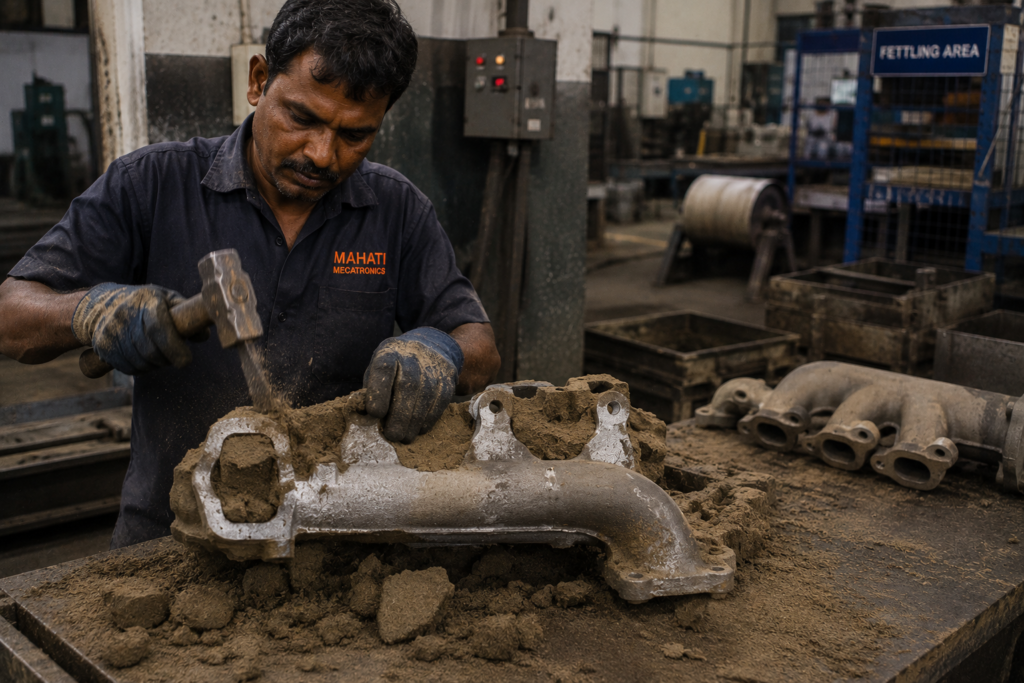
Every casting leaving Mahati as a sand casting manufacturer goes through inspection before dispatch, not just a visual check — a discipline that separates a reliable sand casting manufacturer from one relying on spot checks alone.
Inspection and soundness
Dimensional and soundness checks confirm each casting matches the drawing and is free of porosity or internal defects.
Machining allowance
Machining allowance is built into the pattern so post-cast machining removes only the intended stock, not excess material.
Surface finish
Surface finish is checked against the process expected — shell mould parts should show a visibly smoother finish than green-sand equivalents.
Get a Quote From Our Sand Casting Manufacturer Team
Mahati Mecatronics is a sand casting manufacturer producing CI, SG iron, aluminium, steel and brass parts from its Bangalore facility. Working with an established sand casting manufacturer with in-house pattern making shortens the path from drawing to finished part.
Frequently Asked Questions
A few questions come up regularly when customers first evaluate a sand casting manufacturer for a new part.
Q. What is the difference between sand and shell moulding?
Both use sand, but shell moulding uses resin-coated sand cured on a heated metal pattern, giving better accuracy and finish than conventional green-sand casting.
Q. What parts are best suited to sand casting?
Larger or lower-volume parts and complex geometries such as manifolds, housings and casings are well suited to sand casting.
Q. Which metals can you sand cast?
Cast iron, SG iron, aluminium, steel and brass are all cast using this process.