Shell moulding are the backbone of high-accuracy foundry production. Get the pattern design wrong, and
every casting pulled from it inherits the same flaw — thousands of times over. This guide covers what shell
moulding patterns are, how they’re designed, which materials and tolerances they need, and how Mahati supplies
them foundry-ready from its Bangalore workshop.
For any foundry running repeat production, shell moulding are not a one-time purchase — they’re a piece of
production equipment that has to perform reliably over thousands of heat cycles. That’s why the design and material
choices behind shell moulding deserve the same engineering attention as the castings they produce
What Are Shell Moulding Patterns?
Role in the shell moulding process
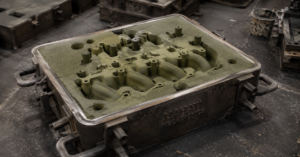
Shell moulding patterns are heated metal tools that resin-coated sand is pressed against, curing into a thin, rigid shell mould. Unlike loose sand, this shell holds its shape precisely — which is exactly why shell moulding patterns need tighter engineering than ordinary sand tooling.
How they differ from green-sand patterns
Green-sand patterns are packed by hand or machine into loose sand and pulled free before pouring. Shell moulding patterns, by contrast, stay heated throughout the cycle and must withstand repeated thermal cycling without losing dimensional accuracy.
Metal patterns and resin-coated sand
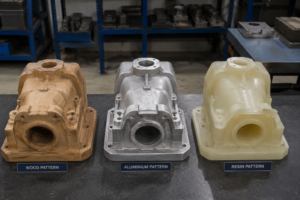
Because shell moulding patterns are heated to around 200–260°C each cycle, they’re almost always machined from aluminium or steel rather than wood — a material that would warp or char under repeated heat exposure.
Designing Patterns for Shell Moulds and Core Shooters
Match-plate mounting design
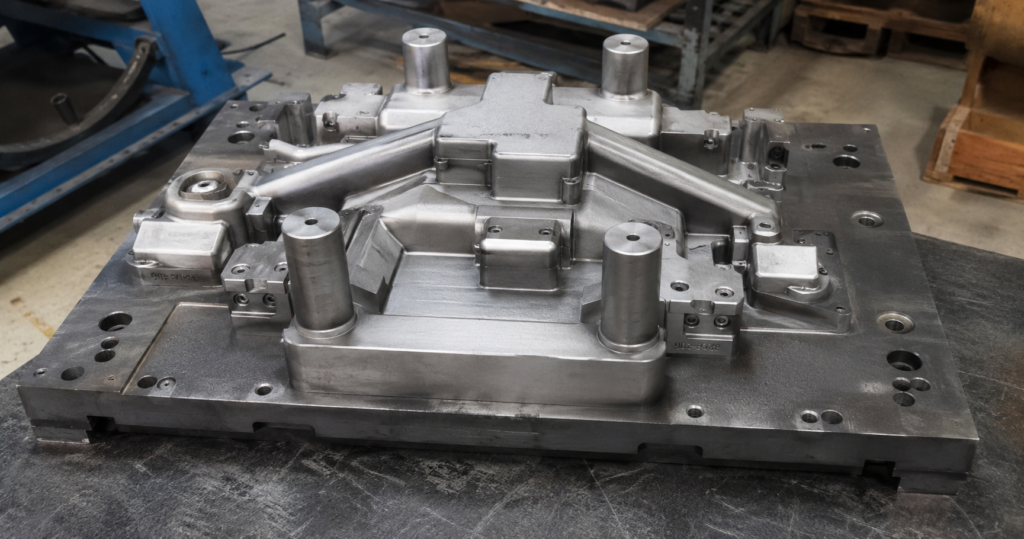
Most shell moulding patterns are mounted on a match-plate, with cope and drag halves positioned opposite each other for consistent alignment cycle after cycle.
Gating and ejection system engineering
Gating channels and ejector pins are built directly into shell moulding patterns during design, not added afterward
— this is what lets the finished tooling run straight into production without rework.
Core boxes for core shooter machines
Core boxes are the companion tooling to shell moulding patterns, used on a core shooter machine to form internal cavities. They’re held to the same tolerance discipline as the main pattern, since a misaligned core box is a common source of wall-thickness variation in the finished casting.
Core box tolerance checklist
- Dimensional check against the original drawing before first trial shot.
- Parting line and vent placement verified for clean sand release.
- Wear surfaces inspected for hardness and finish before dispatch.
Materials and Tolerances for Shell Patterns
Pattern material selection
Aluminium is the standard material for shell moulding patterns in low-to-medium volume work; hardened steel is used where tens of thousands of cycles are expected. Choosing correctly at this stage avoids replacing shell moulding patterns mid-contract.
Achievable tolerances and surface finish
Well-engineered shell moulding patterns typically hold tolerances tighter than green-sand tooling, along with a smoother as-cast surface finish that reduces downstream machining. This accuracy is the main reason customers specify shell moulding patterns over conventional sand tooling for dimensionally critical parts.
Typical tolerance & finish reference
| Pattern type | Typical tolerance | Surface finish |
| Green-sand pattern | ±0.8–1.5 mm | Coarse |
| Shell moulding pattern | ±0.3–0.5 mm | Smooth, near-net-shape |
Heat and wear considerations
Because shell moulding patterns are reheated every cycle, wear surfaces and ejector components need periodic inspection — a maintenance step worth planning for at the design stage, not after cracks appear.
How We Supply Foundry-Ready Shell Patterns
Supplying shell moulding patterns is a five-stage process at Mahati, from initial drawing review through to a trial shot on the foundry floor.
From spec to finished equipment
Every set of shell moulding patterns starts from a customer drawing or sample, moves through CAD modelling with correct allowances, and is then CNC machined in-house.
In-house inspection
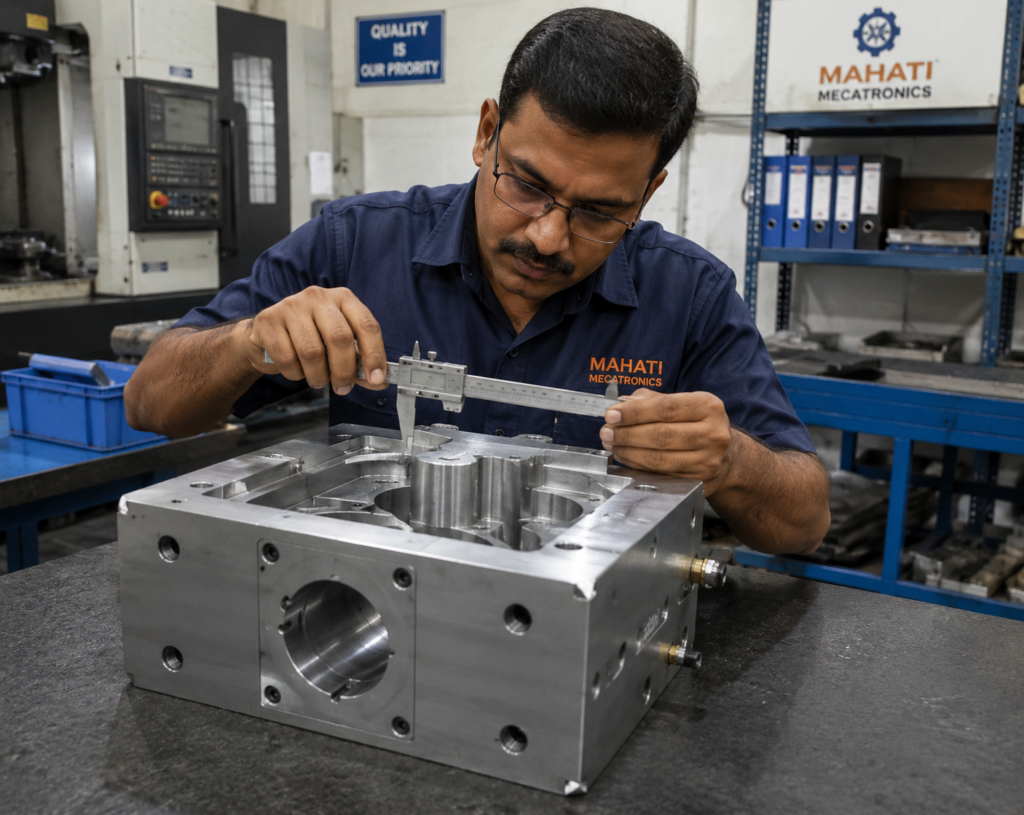
Before dispatch, shell moulding patterns are dimensionally checked against the original drawing, and core boxes are verified the same way.
Dispatch ready to run
The goal of every shell moulding patterns project at Mahati is equipment that runs on the foundry floor from day one — match-plate mounted, gating and ejection fitted, and dimensionally verified.
Get Your Shell Moulding Patterns Quoted
Mahati Mecatronics engineers foundry-ready shell moulding patterns and core boxes in Peenya, Bangalore.
Frequently Asked Questions
Q. What is shell moulding used for?
Shell moulding produces high-accuracy, good-finish castings for parts like manifolds, valve bodies and cylinder head cores, using resin-coated sand hardened against a heated metal pattern.
Q. Why use metal patterns for shell moulding?
Shell moulding needs heated, durable patterns that hold tight tolerances over long runs, which is why metal (often aluminium or steel) patterns are standard.
Q. Do you engineer the gating and ejection system?
Yes — match-plate mounting, gating and ejection are independently engineered so equipment arrives foundry-ready.