Table of Contents
Investment casting is the process to reach for when a part needs complex geometry, fine detail, and a surface finish that other casting methods simply can’t match as-cast. This guide covers how investment casting works, when it’s the right choice, its role in aerospace-grade work, and how a part moves from design through to delivery.
Because investment casting captures such fine detail, it’s often the process that saves the most downstream machining cost — even though the per-part casting cost is usually higher than sand or die casting.
What Is Investment Casting?
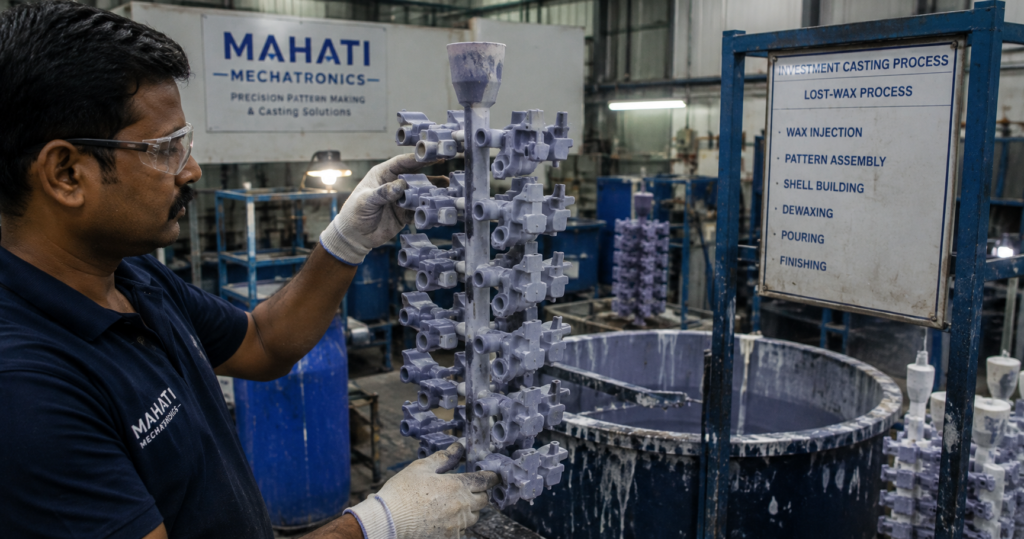
The lost-wax process step by step
Investment casting builds a wax replica of the part, coats it in ceramic slurry, then melts out the wax and pours metal into the resulting ceramic shell — the reason it’s also called lost-wax casting.
Why it achieves fine detail and finish
Because the ceramic shell captures the wax pattern’s surface in fine detail, investment casting reproduces features other processes can’t achieve without heavy secondary machining.
Materials it supports
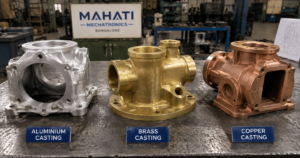
Investment casting isn’t limited to one metal family — steel, iron, aluminium and brass are all routinely cast this way.
Materials supported at a glance
| Material | Common application |
| Steel | Aerospace, structural precision parts |
| Iron | Valve and pump components |
| Aluminium | Lightweight precision housings |
| Brass | Fittings, decorative components |
When to Choose Investment Casting
Complex geometry and thin sections
Investment casting is the natural choice when a part combines complex geometry with thin sections that other processes would struggle to fill cleanly.
Near-net-shape to cut machining
Because investment casting delivers near-net-shape accuracy, machining is often reduced to light finishing rather than heavy stock removal.
Small-to-medium precision runs
Investment casting suits small-to-medium volumes where precision matters more than the fastest per-part cost — high-volume simple parts are usually better served by die casting instead.
Aerospace and Critical Applications
Aerospace-grade MGB housings
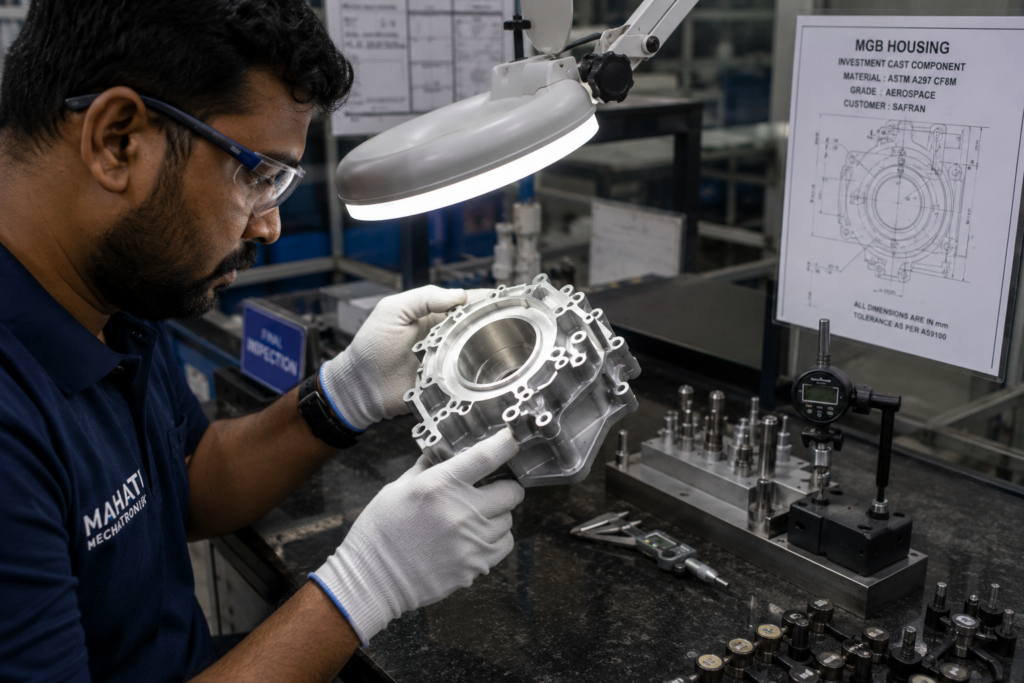
Investment casting is the standard choice for aerospace and defence components, including MGB (helicopter gearbox) housings, where tight tolerances and material integrity are non-negotiable.
Quality and traceability
Aerospace-grade investment casting work carries full material traceability and inspection documentation from wax pattern through to finished part.
Meeting tight specifications
Every critical-application investment casting is checked against the customer’s specification before it’s approved for dispatch.
Critical inspection checklist
- Dimensional verification against the drawing.
- Material certificate and batch traceability.
- Surface and internal soundness checks where specified.
From Design to Delivery
Tooling for wax patterns
Wax injection tooling is engineered first, since every subsequent investment casting step depends on an accurate wax pattern.
Inspection
- Review drawing and confirm material for the investment casting project.
- Build and inspect the wax pattern tooling.
- Cast and inspect a first-article sample.
- Approve for full production.
Finishing and dispatch
Finished investment casting parts are cleaned, inspected, and dispatched with documentation matching the specification agreed at quoting.
Talk to Our Investment Casting Team
Mahati Mecatronics produces investment casting components, including aerospace-grade parts, from its Bangalore facility.
Frequently Asked Questions
Q. What is investment casting best for?
It is best for complex, high-precision parts needing excellent surface finish and near-net-shape accuracy, reducing downstream machining.
Q. Can investment casting be used for aerospace parts?
Yes — aerospace-grade components including MGB (helicopter gearbox) housings are produced by investment casting.
Q. Which materials can be investment cast?
Steel, iron, aluminium and brass are all suitable for the investment casting process.