Table of Contents
When a part needs thin walls, fine detail and very high volume, pressure die casting is usually the answer. This guide covers how pressure die casting works, how low pressure die casting differs, the benefits for your part, and the design considerations that affect tooling and quality.
Pressure die casting is one of the fastest-cycling processes available, which is exactly why tooling and design decisions upfront matter so much — mistakes get repeated at very high speed.
How Pressure Die Casting Works
High-pressure injection into a steel die
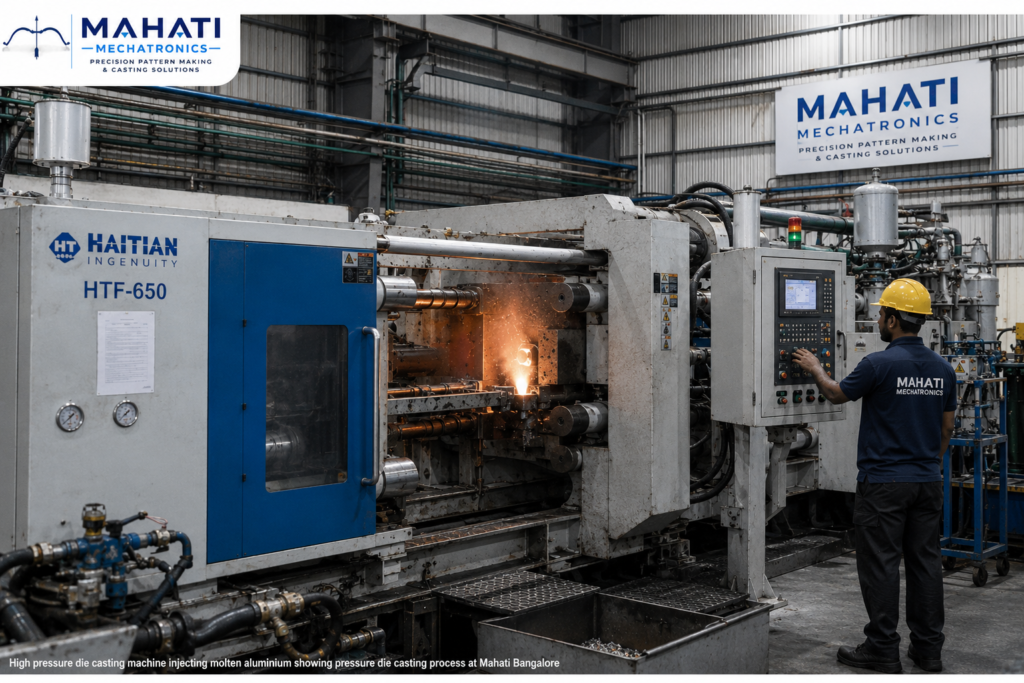
Pressure die casting forces molten metal into a steel die at high speed and pressure, filling even thin sections before the metal can begin to solidify prematurely.
Thin walls and complex geometry
The speed and pressure involved is what makes pressure die casting capable of thin walls and fine detail that gravity or sand processes can’t reliably reproduce.
Cycle speed and volume
Of all common processes, pressure die casting has the fastest per-part cycle time once tooling is in place, making it the standard choice for very high volumes.
Typical cycle time by process
| Process | Typical cycle time |
| Sand casting | Minutes to hours (per mould) |
| Gravity die casting | 2–5 minutes |
| Pressure die casting | 30 seconds–2 minutes |
Low Pressure Die Casting
How low pressure filling differs
Unlike high-pressure injection, low pressure die casting fills the die gently from below using controlled air pressure
— slower, but gentler on the metal.
Denser, sounder parts
This gentler fill is why low pressure die casting produces denser, more pressure-tight parts than high-pressure methods, suited to safety-critical components.
Best-fit applications
Wheel hubs, valve bodies and other pressure-bearing parts are common candidates for low pressure die casting rather than high-pressure injection.
Benefits for Your Part
Tight tolerances
Both pressure die casting variants hold tighter tolerances than sand or gravity die processes, reducing the need for secondary machining.
Reduced finishing operations
- Near-net-shape parts straight from the die.
- Minimal machining stock required.
- Consistent surface finish across the full run.
Repeatability at scale
Pressure die casting tooling, once validated, repeats the same result thousands of times over — a core reason high-volume OEM buyers specify it.
Design and Tooling Considerations
Wall thickness and draft
Consistent wall thickness and adequate draft angle are essential design inputs for pressure die casting — inconsistent walls cause defects at high injection speed.
Wall thickness quick checklist
- Keep wall thickness as uniform as possible across the part.
- Apply draft angle to every vertical face for clean ejection.
- Avoid sudden thickness transitions that trap air or cause porosity.
Die material and life
Steel dies for pressure die casting are engineered for a specific expected cycle life, balancing tool steel grade against production volume.
Validation and quality
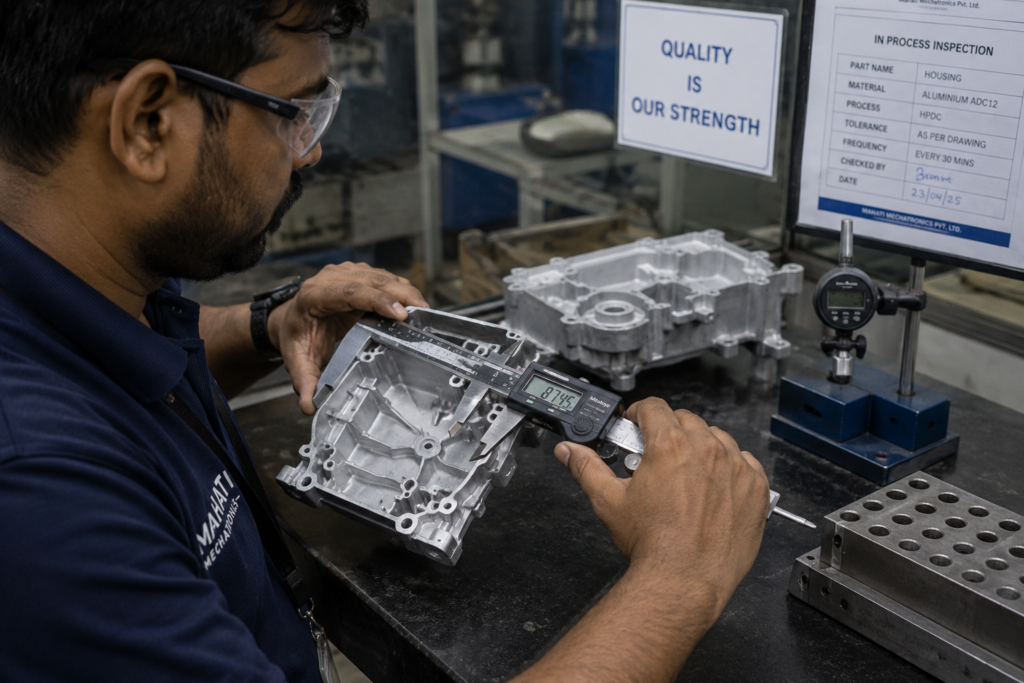
First-article samples are checked against the drawing before full-volume pressure die casting production begins.
Talk to Our Pressure Die Casting Team
Mahati Mecatronics produces pressure and low pressure die casting components for high-volume, precision applications from its Bangalore facility.
Frequently Asked Questions
Q. What is the difference between high and low pressure die casting?
High pressure die casting forces metal in at high speed for thin walls and high volume, while low pressure uses controlled low pressure for denser, more pressure-tight parts.
Q. Why does pressure die casting reduce finishing?
The process produces near-net-shape parts with tight tolerances and good finish, so less machining and secondary work is needed.
Q. Is pressure die casting suitable for complex shapes?
Yes — it excels at intricate thin-wall shapes and complex geometries at high volume.